

The first Open Dialogue RCT has been published.
The findings are thrilling. The findings are null. The findings are promising. Or maybe disappointing… These findings can be whatever you want them to be. There is something there for everybody.
Open Dialogue has generated a lot of enthusiasm since it emerged in Finland in the 80s as a novel approach to treating psychosis. It racked up some evidence over the year as it spread internationally, but had never been subjected to a randomised controlled trial. Ten years ago, UK-based researchers embarked on an ambitious project to do just that. So after such a long wait, it’s a big deal that the ODDESSI RCT is finally out.
The results have fuelled media excitement. They have sparked academic critique. They have drawn praise, and calls for expanded provision. Their dissemination received a rebuke from the very journal that published the trial.
In short, the primary outcome — time to relapse — showed no significant difference compared with treatment as usual. But there were enough significant, and striking, results amongst the secondary outcomes (e.g. lower rate of hospitalisation and greater self-reported satisfaction with services) for OD advocates to celebrate it as a success. However, RCT ethos denotes that primary outcomes should be just that. As such, the emphasis placed on secondary outcomes that favour OD, over the primary outcome that does not, has antagonised some researchers.
There has been intense debate about what these results represent, how they should be interpreted, and what they mean for the future of OD in the UK, and indeed the future of NHS mental health services more broadly.
Yet the vigour of these debates is perhaps unsurprising, because Open Dialogue seems to have a particular capacity to galvanise and inspire clinicians on the one hand, and to polarise and repel on the other.
Some friction was already notable during the conduct of the RCT, according to an ethnographic study by Chase and Mosse. They suggest the OD practitioner advocates and the trial researchers embodied two different moral philosophies. The researchers were situated within a utilitarian philosophy, which judges actions based on their consequences, and seeks to maximise positive outcomes, in this case through the tools of evidence-based medicine. The practitioner advocates, on the other hand, were situated within a “virtue ethics” framework, in which actions are judged first and foremost by the virtues they embody. From this perspective, the results of the trial mattered less than the inherent virtue of OD, as summed up by a quote from one of the interviewees:
“Morally and ethically it’s quite hard to argue against the principles of it. So, what exactly are we worried about? Why is there even the ODDESSI trial? Because should we not just be doing this stuff?” (participant, Chase & Mosse, 2025, p.644)
These contrasting philosophical positions go some way to explaining tensions around the trial. But I think this misses something important — the role of identity and group dynamics.
As such, beyond all the discussion about primary vs secondary outcomes etc., what caught my attention was a post by Mark New, a support worker in a service that almost participated in the ODDESSI trial. Mark underwent the OD training — a one-week residential retreat — and describes his misgivings about the atmosphere of intense fervour and lack of space for questioning, or for critical or alternative perspectives.
Mark’s reflections resonate strikingly with a systematic review I spent the last few years working on. I thought I’d offer a snapshot of the findings, as they might illuminate the curious controversy that has swirled around this RCT.
TL;DR: Open Dialogue training and practice often forges cohesive, values-driven and committed groups of practitioners with a strong, shared social identity. This can be beneficial in many ways. However, when this group identity is strong, homogenous and ideologically charged, damaging intergroup tensions and competition can emerge.
What is OD?
If you want a full lowdown on Open Dialogue, there’s a good overview of the key principles here.
In short, it has two key components:
A particular relational stance in the moment with service users
An overall model for delivering mental health services
The relational stance is characterised by tolerating uncertainty (not rushing to decisions about treatment), valuing all voices, and levelling hierarchies (between professionals, and between professionals, service users and their social networks). In other words, professional “expertise” is not invested with more power and importance than the voice of lived experience.
In the service of this, Open Dialogue is steeped in the philosophy of Mikhail Bakhtin, a Russian literary critic who developed the concept of polyphony (multi-voicedness) through his analysis of Dostoyevsky’s novels. This concept of polyphony, and valuing multiple different perspectives, is one I will return to.
Open Dialogue implementation issues
Reading through studies looking at Open Dialogue implementation, I was struck by how organisations often encountered difficulties and conflicts, which sometimes proved insurmountable. These issues often revolved around identity dynamics, and the extent to which staff developed identities compatible with OD.
So, myself and colleagues conducted a systematic review and meta-ethnography (a method for synthesising and interpreting qualitative papers) looking at clinician experiences of identity change when implementing or training in Open Dialogue. The full paper, which included 23 studies, is available open access here.
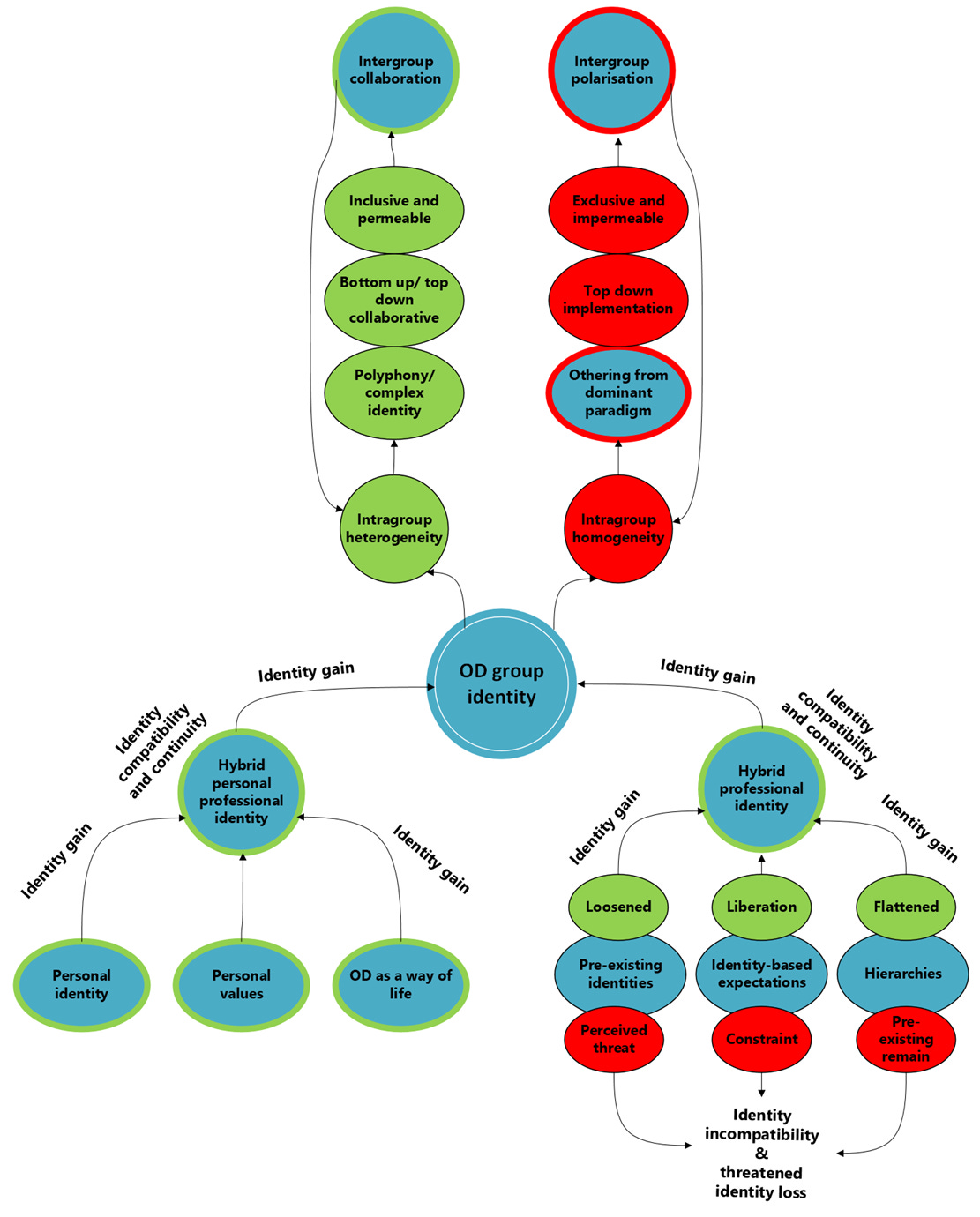
Through the synthesis, we derived four overarching themes and 11 subthemes, as you can see in the figure below.
Personal identity: the “satisfaction of being yourself”
Broadly, many clinicians experienced OD as an immensely rewarding way of working.
Particularly striking was the way OD practitioners described connecting with a ‘personal self’, and shedding their purely professional identity. There was a sense that OD training and practice allowed them to be themselves, or to “be authentic”. This coherence was presented as a contrast to the way they usually separated their personal and professional selves, and felt inauthentic at work.
“it’s like we actually get to do what we went to school for you know, or what our passions were” (participant, Uehling et al., 2024, p.4)
This was driven by a sense that OD principles aligned with their personal values, described as “philosophical fit” in one paper. OD was often perceived as more than just learning and deploying new skills and knowledge, but rather as a new “way of life” or “way of being”, that spilled over into their personal lives.
This had potential implications for wellbeing and burnout:
“I think a lot of the reason why I would get burned out was just being involved in things that didn’t feel good, that were inhumane, or that were taking people’s freedom away, or autonomy away and just watching the system be so cruel to the people that I am getting paid to help, year after year, it’s just horrible. And this work is probably the most humane way of work that I’ve ever done.” (participant, Florence et al., 2020, p.687)
Indeed, in the ODDESSI results presentation, Professor Russell Razzaque, a consultant psychiatrist and joint last author on the paper, said that, in his service in Havering, the treatment as usual team saw 100% staff turnover between 2017 and 2023. In the OD team, staff turnover was just 20%1. “When you go through this training, it creates a really cohesive team,” he explained in the presentation.
Shared OD group identity
The identity processes that unfolded within and between individuals contributed to the development of a shared Open Dialogue group identity.
Social identity theory provides a useful theoretical lens here. It offers a framework for understanding how people’s perception of group membership shapes their sense of self. When a social identity is salient in a given context, individual identity is subsumed within it. The individual perceives themselves more as a member of a group than as an individual. This can contribute to group cohesion and co-operation, but also intergroup conflict.
The development of this shared group identity was catalysed by several factors that are particular to OD:
The encouragement to share intimate personal stories nurtured close bonds between practitioners.
Intense residential training courses provided the conditions for rapid identity formation
Letting go of pre-existing professional identities (i.e. no longer identifying first and foremost as a psychiatrist or a mental health nurse, but rather as an OD practitioner).
The flattening of hierarchies dissolved the sense of difference and power differentials between practitioners, and fostered togetherness2.
Organisational research has linked social identification with numerous beneficial outcomes, including staff well-being, and motivation and well-being amongst care workers. These benefits were apparent in many of the studies included in the review.
Intergroup polarisation
But although the shared OD group identity could nurture cohesion and energise practitioners, it could also lead to challenges.
In some studies, the OD group identity was strong, homogenous and exclusionary. This was particularly notable when implementation was imposed by management from the top down, or when the OD group identity was ideologically charged. And sometimes this ideological charge was intense.
The sub-theme “Othering from the dominant paradigm”, captures how professionals aligned themselves with OD as ethically superior. This involved othering themselves from, and denigrating, the perceived dominant medical paradigm.
The “superior” part of this othering is important: this was not a case of saying, “here is an alternative”, but rather, “here is the alternative”. Implicit in this was an attack on people who don’t align themselves with OD.
“I think that there is a danger that people who practice OD see themselves as superior and this can be experienced as a provocation… as if in their infinite wisdom they know it all or they are better than other staff” (participant, von Peter et al., 2022, p. 3).
“[name of colleague] was there almost like a guru, a completely different person as far as I knew before. Hallelujah, how wonderful OD was and how we have all been doing it wrong so far” (participant, Lorenz-Artz et al., 2023, p. 8).
This is a dynamic that Mark New also mentions experiencing during his training:
“I felt a real case of ‘if you’re not with us, you’re against us’ emerging. Not merely a rejection of traditional healthcare, but a denouncement.”
In 11 papers, these kinds of ideological polarities provided fertile terrain for intergroup tensions.
Such processes have long been examined in social identity theory research. Outgroups are often perceived as threatening, particularly when they are represented as strong entities. This dynamic seems particularly likely to emerge when OD is framed as an underdog pushing back against a dominant, and therefore threatening, paradigm.
When important aspects of one’s self-concept are related to a group identity, one is motivated to enhance that ingroup identity, and draw favourable comparisons with outgroups. This social identity lens perhaps partly explains the allure of secondary outcomes that show superiority to TAU, over a primary outcome that does not.
Intergroup collaboration
Intergroup tensions were not always inevitable or intractable. Across seven papers these intergroup polarities were softened, dissolved, or avoided in the first place.
Instead of intergroup polarisation, intergroup collaboration was more likely to occur when:
The OD group identity was heterogeneous, and made space for difference, nuance and complexity; in short, when the group identity was polyphonic
When implementation was bottom up, or top down and collaborative
When the OD group was inclusive, with permeable boundaries
Some services did manage to attain this intergroup collaboration, although it was far from the norm. This raises important questions about how the benefits of social identification—group cohesion, collaboration, self-esteem and sense of purpose—can be harnessed, without unleashing problematic intergroup conflicts. Organisational interventions derived from social identity theory hold some promise. But also, embedded within Open Dialogue philosophy is a potential solution.
Polyphony is a core OD principle. As such, it is a tragic irony when OD implementation is characterised and derailed by its opposite—monologism—as highlighted by Florence and colleagues. Welcoming polyphony may be crucial in avoiding the polarisation that has at times hampered OD implementation, and has emerged around the ODDESSI dissemination.
As Bakhtin writes:
“Truth is not born nor is it to be found inside the head of an individual person, it is born between people collectively searching for truth, in the process of their dialogic interaction.” (Bakhtin, 1984, Problems of Dostoyevsky’s Poetics, p.110)
This dialogic interaction ought to occur not just within OD circles, but between OD and the wider community of researchers and practitioners.
Conflicts of interest to declare: I love Bakhtin.
Hopefully this data will be published in a peer reviewed journal as it is quite striking, and will be important to consider in its fullness.
Conversely, the cultivation of a shared OD group identity struggled when OD was perceived as threatening one’s pre-existing professional identity, and when professionals remained strongly attached to pre-existing professional hierarchies.
The distinction of primary and secondary outcomes is silly when it comes to interpretation of an RCT. The results are equally robust, if they choose not to care about secondary outcomes that is their deal.